
Accomack Court Records After Arrest
After an Accomack jail arrest, the jail record and the court record are related but separate. The jail side confirms intake, custody, bond questions, and release or transfer. The court side tracks the formal case once an officer, magistrate, clerk, prosecutor, or grand jury brings the charge into the Virginia court system. That distinction matters because a jail inmate record can show current custody while the court case shows what charge is pending, amended, dismissed, or resolved.
The Accomack Commonwealth's Attorney prosecutes felony and misdemeanor criminal cases for Accomack County and the Commonwealth of Virginia in Juvenile and Domestic Relations District Court, General District Court, and Circuit Court. Virginia uses the title Commonwealth's Attorney rather than District Attorney. The office has discretion over whether a defendant should be prosecuted and how the case should proceed, and criminal cases are brought in the name of the Commonwealth.
Booking photos and jail-photo questions belong with jail roster mugshots. Court records after a jail arrest focus on charges, court dates, bail, warrants, dispositions, fines, and clerk records.
Court Path After Jail Arrest
The path from arrest to court record is a sequence, not a single database entry. A person may be arrested on a warrant, capias, summons-eligible offense, or probable cause. If a summons is not used, Virginia Code § 19.2-80 requires the arrested person to be brought before a judicial officer without unnecessary delay. The judicial officer decides bail or commitment. If committed, the person may be booked into Accomack County Jail or another holding facility.
- Arrest and booking create the custody side of the record and may place the person in Accomack County Jail.
- A judicial officer or magistrate handles bail, release, or commitment when the arrest process requires that review.
- General District Court handles many misdemeanors, traffic-criminal matters, and early felony stages.
- The Commonwealth's Attorney reviews prosecution decisions, amendments, reductions, dismissals, and indictment choices.
- Circuit Court handles felony indictments, appeals, and criminal cases within the court of general jurisdiction.
- The clerk or online court portals show formal charges, hearing dates, dispositions, fines, and costs when public access is available.
Search Accomack Court Records
Virginia court portals are the main online source for Accomack County court records after a jail arrest. The statewide case information page routes users to statewide adult criminal data, Circuit Court case information, General District Court case information, and JDR options where public access is allowed. The General District system can also handle online payments for eligible cases, while the statewide OCIS search does not take payments.
The Virginia Case Status and Information page lists the major court case access options for criminal and traffic case status.
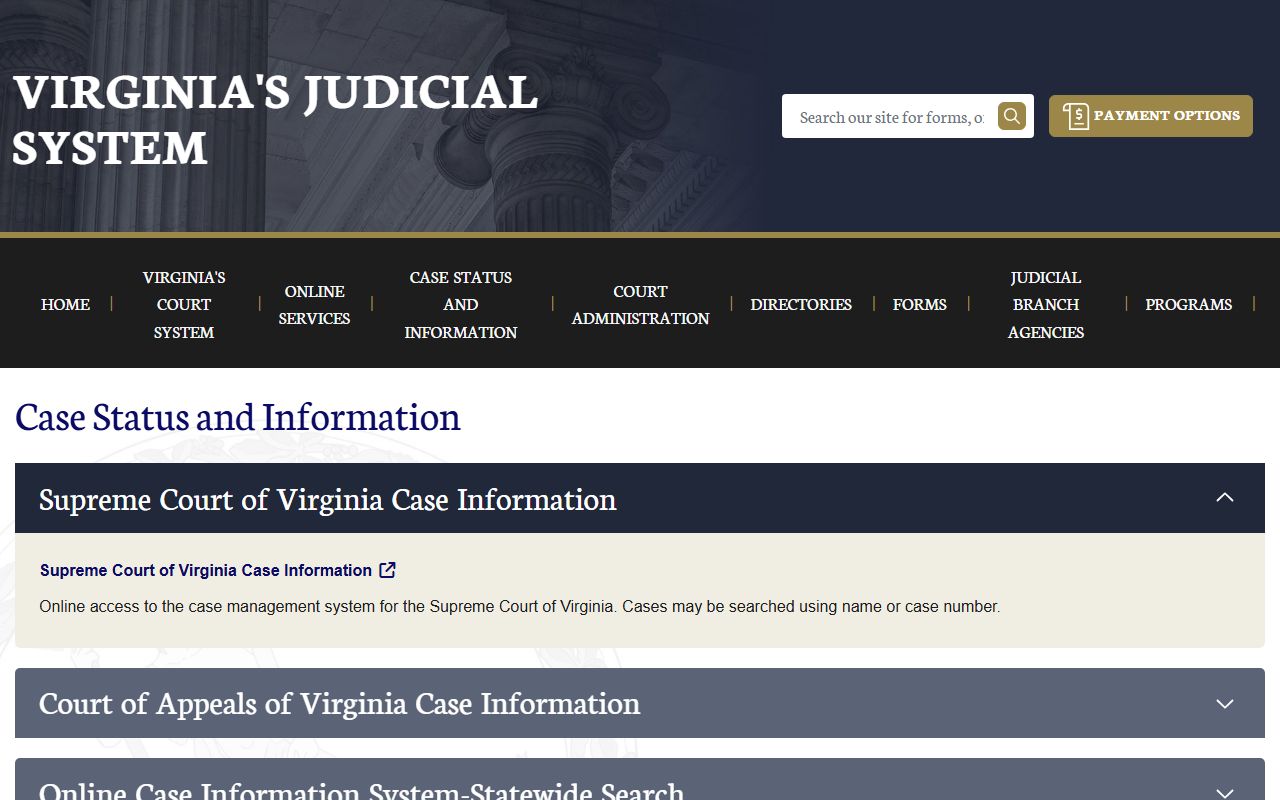
Use the court portal when the question is the filed charge or hearing date rather than whether the person is still in jail.
| Field Label | Type | Required | Options / Format Notes |
|---|---|---|---|
| Court/locality | Dropdown or filter | Yes for locality portals | Select Accomack or the correct court/locality. |
| Name | Text | Optional path | Use defendant name for criminal cases. |
| Case number | Text | Optional path | Use if known from a warrant, summons, clerk, or jail record. |
| Hearing date | Date | Optional path | Search by hearing date for docket or case lookup. |
| Case type or court level | Filter/tab | Varies | Statewide search covers adult criminal JDR, general district criminal/traffic, and select circuit courts. |
Charging Documents After Arrest
Formal court records after a jail arrest are built from charging documents and court entries. The first booking language may come from the arresting agency, but the court record follows what is filed or pursued in court. In Virginia, felony cases may begin in district court and later move by indictment to Circuit Court. A capias or warrant can also become the custody bridge when a person misses court, violates probation, or fails to report.
| Document | Who Uses It | Common Role | What to Check |
|---|---|---|---|
| Warrant | Judicial officer or magistrate process | Authorizes arrest based on a charge or probable cause | Charge, case number, issuing court, bond status. |
| Summons | Officer or court process | Orders court appearance without immediate jail commitment in eligible cases | Court date and charge filed. |
| Capias | Court | Orders a person taken into custody, often for failure to appear or failure to report | Underlying case and whether bond is allowed. |
| Indictment | Grand jury | Moves or files felony charges in Circuit Court | Indictment date, felony count, and next Circuit Court event. |
| Information or amended charge | Prosecutor and court | Changes, reduces, or formalizes charge language | Whether the active court charge differs from booking language. |
Accomack Charge Status Records
Charge status terms explain where the court case stands after the arrest. A pending charge is not a conviction. A dismissal or nolle prosequi can end a charge without guilt. An amended or reduced charge means the court record changed after the first filing. These terms should be read one charge at a time because a single Accomack County arrest can create several counts with different outcomes.
| Status | What It Means | Why It Matters |
|---|---|---|
| Pending | The charge has been filed but not resolved. | Future hearings or prosecutor action may still change the case. |
| Amended or reduced | The original charge was changed by prosecutor or court action. | The final charge may differ from the jail booking charge. |
| Dismissed | The charge ended without a conviction. | Dismissal does not always remove public court history automatically. |
| Nolle prosequi | The prosecutor elected not to proceed on that charge. | It is a prosecutor decision, not the same as an acquittal. |
| Convicted or guilty | The court entered a guilt finding or accepted a plea. | Sentencing, fines, costs, probation, or custody consequences may follow. |
| Deferred | The court delays or withholds final outcome under a statutory program. | Eligibility and final result depend on the statute and compliance. |
| Probation violation | The case alleges violation of supervision terms. | A capias or no-bond hold may result. |
Accomack Court Levels
Accomack court records after a jail arrest can appear in more than one court. The court level depends on charge type, age or family-law context, case stage, and whether the matter has been indicted or appealed. The Clerk of Circuit Court page also notes the county's long public-record tradition and maintains criminal records for Circuit Court cases heard in Accomack County.
The Accomack Clerk of Circuit Court page gives the local clerk contact and public records room details.
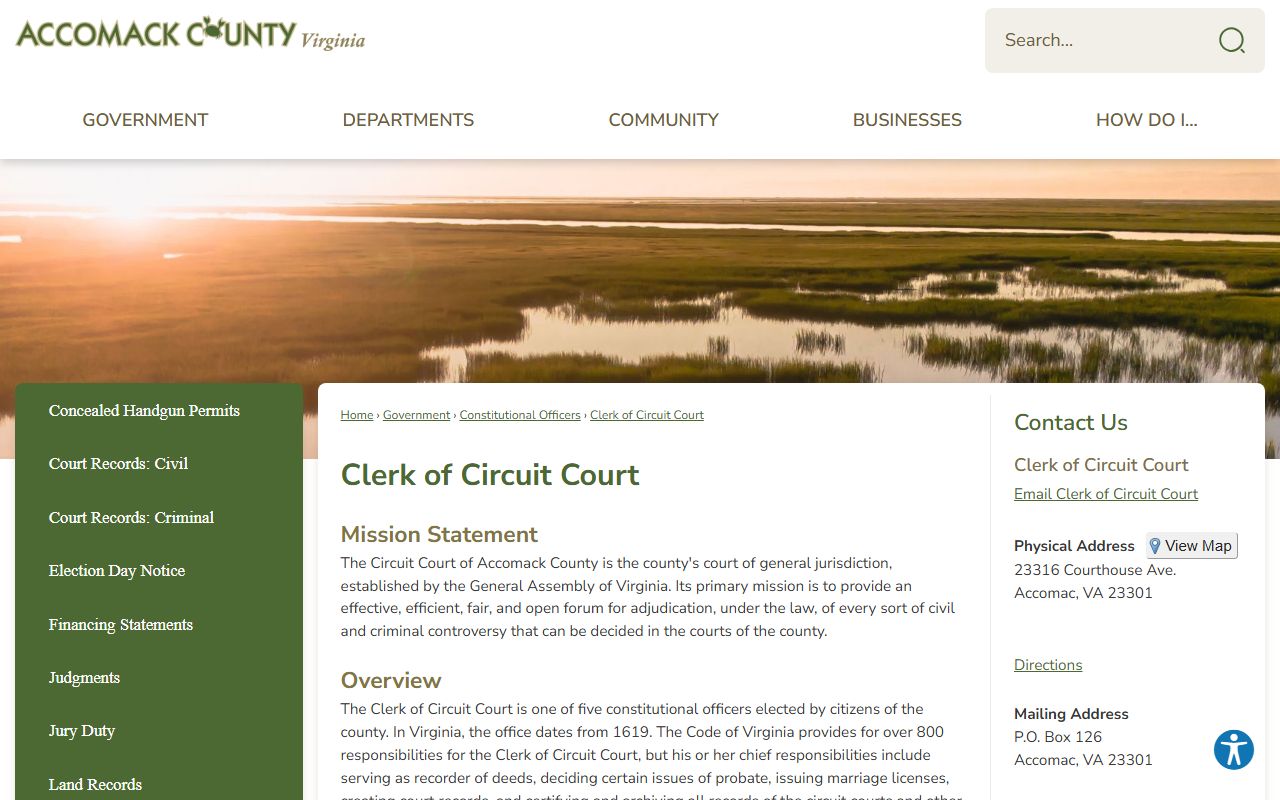
The clerk source is most relevant when the case has reached Circuit Court or when copies must come from the local records office.
| Court or Office | Role After Arrest | Contact Detail From Research |
|---|---|---|
| General District Court | Misdemeanors, traffic-criminal matters, and felony preliminary stages. | 23371 Front Street, Accomac, VA 23301; (757) 787-0923. |
| Juvenile and Domestic Relations District Court | Juvenile and domestic-relations criminal matters, plus adult criminal items on its schedule. | Clerk Roland C. Leighton; (757) 787-0920; 23371 Front Street. |
| Circuit Court | Felony indictments, criminal controversies, appeals, and Circuit criminal records. | Clerk Talia C. Taylor; (757) 787-5776 / (757) 824-4318; 23316 Courthouse Ave. |
| Commonwealth's Attorney | Prosecution decisions, charge changes, felony prosecution, and discretionary misdemeanor prosecution. | 22477 Center Parkway, Accomac, VA 23301; (757) 787-2877. |
Commonwealth Attorney Charge Role
The Accomack Commonwealth's Attorney is the prosecutor for criminal cases brought in the name of the Commonwealth. The official office page says the office prosecutes felony and misdemeanor criminal cases in JDR, General District, and Circuit Courts. It also states that the office has sole discretion over whether a defendant should be prosecuted and how the case should be tried.
That role explains why court records after a jail arrest can shift. The arresting agency may list one booking allegation, but prosecutor review can lead to amended charges, reduced charges, dismissed counts, or indictment. The office can also decide whether to pursue discretionary misdemeanor prosecution. The office does not provide legal counsel to individual citizens, so case-specific legal advice must come from a lawyer.
Bail Magistrate Court Path
Bail and custody status often sit between the jail record and the court record. Virginia Code § 19.2-80 requires an arrested person on a warrant or capias who is not released by summons to be brought before a judicial officer without unnecessary delay. Virginia Code § 19.2-120 addresses admission to bail unless statutory detention concerns apply, and § 19.2-121 covers fixing bail terms and transmitting bail-hearing information in certain cases.
| Release Term | Meaning | Accomack Search Note |
|---|---|---|
| Recognizance or PR | Release on a promise to appear and follow conditions. | Check court entries for next hearing and conditions. |
| Unsecured bond | Money is owed only if conditions are violated. | Confirm details with court or jail before relying on a summary. |
| Secured bond | Money, property, or surety secures release. | Call the jail to ask where bond is accepted and what ID is required. |
| Cash bond | Cash payment is used to secure release. | Accepted Accomack payment methods were not located in official jail pages. |
| No-bond hold | Release is blocked until further court action or another hold resolves. | A capias, probation hold, ICE detainer, federal hold, or outside warrant may block release. |
Warrants Capias Arrest Records
The Accomack Sheriff's Office did not publish a separate official searchable active-warrant database in the pages reviewed. It does publish a Most Wanted page and a tip form. The Most Wanted page is a selected public wanted-person notice, not a complete warrant roster. It can include photos, demographic fields, last known location, charge descriptions, and instructions to call the sheriff's office.
A bench warrant or capias often starts in an existing court case. Search court records by defendant name, case number, or hearing date, then contact the relevant clerk if the entry is unclear. For a recent arrest on a warrant or capias, call Accomack County Jail at (757) 787-1095 to ask whether the person is currently committed. Routine warrant checks should use the sheriff line, not emergency dispatch.
- Arrest warrant
- Process authorizing arrest based on a criminal charge or probable cause.
- Bench warrant or capias
- Court process often tied to failure to appear, failure to report, or violation of a court order.
- Fugitive warrant or hold
- A warrant or hold involving another jurisdiction or another pending case.
- Probation-violation capias
- Court process for an alleged violation of supervision terms.
Charges Versus Convictions
Accomack County court records after a jail arrest should be read with the stage in mind. A charge is an accusation in the court system. A conviction is a court result after a guilty plea, verdict, or other guilt finding. One arrest can produce several charges, and each charge can have its own status.
| Point | Charge | Conviction |
|---|---|---|
| Stage | Filed accusation or count in a criminal case. | Final or accepted guilt finding on a count. |
| Proof level | May begin with probable cause or filed process. | Requires guilty plea, verdict, or court finding under the criminal standard. |
| Record meaning | Shows what was alleged or pursued. | Shows the outcome and may trigger sentence, fines, probation, or custody. |
| Can change | May be amended, reduced, dismissed, or nol prossed. | Can be appealed or later affected by court orders, but it is not just an accusation. |
Sealed Versus Expunged Records
Virginia's sealing chapter is relevant when a person asks why court records after a jail arrest are no longer visible, or how public access might be limited after an eligible result. Sealing means public access is barred for covered records in court, police or sheriff, Central Criminal Records Exchange, and DMV custody except for authorized purposes. Expungement is a separate court-driven concept often discussed with nonconviction records, and eligibility is fact-specific.
| Point | Sealed | Expunged |
|---|---|---|
| Public visibility | Hidden from ordinary public inspection when a sealing order applies. | Generally treated as removed from public access under the applicable court order. |
| Who may still access | Authorized agencies or uses may still have limited access. | Access depends on the expungement law and order. |
| Record holders | Can affect court, sheriff or police, CCRE, and DMV records when covered. | Usually requires attention to the court file and related criminal-history record. |
| Practical step | Check the court order and the originating office. | Seek legal advice before assuming online records will disappear everywhere. |
Copies and Restricted Records
Copies of Accomack court records may come from the online portal, the Clerk of Circuit Court, General District Court, JDR Court, or the sheriff, depending on the record. Juvenile matters, sealed records, active investigative material, and sensitive law-enforcement records may be restricted. Virginia FOIA and law-enforcement record rules allow public access to many records, but they also allow or require withholding and redaction in specific situations.
For sheriff-held records tied to a jail arrest, use FOIA and identify the existing record with reasonable specificity. For court-filed charges, hearing dates, dispositions, fines, and costs, start with Virginia court systems or the relevant clerk. The Accomack criminal-records research also notes that Circuit criminal fines can be paid by cash, check, certified check, VISA/MasterCard, and VJOPS call-in payments with a 4 percent convenience fee.
Important: A public case lookup is not a consumer report and should not be used for FCRA-covered decisions.